
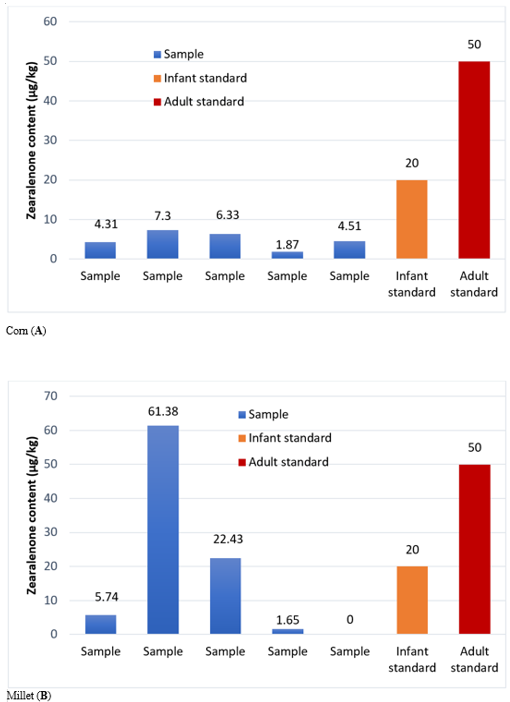
Zearalenone is a carcinogenic contaminant frequently found in cereal-based foods. This study aimed to determine the level of zearalenone contamination in maize and millet porridges sold in the municipality of Yopougon, Abidjan. It was a cross-sectional study. Five grams of ground material from each of the ten samples were extracted with 50 ml of ultrapure water and 50 ml of dichloromethane. After filtration and decantation, zearalenone was detected and quantified by HPLC-FLD. It was detected in four (4) of the five (5) millet porridge samples, with a minimum concentration of 1.65 µg/kg, a maximum concentration of 61.38 µg/kg, and a mean concentration of 18.24 µg/kg. Regarding maize porridge, zearalenone was detected in all five (5) samples, with a minimum concentration of 1.87 µg/kg, a maximum concentration of 7.30 µg/kg, and an average concentration of 4.86 µg/kg. According to reference values, the zearalenone content of the maize porridge is acceptable. However, for millet porridge, three (3) samples met the standards for infants and four (4) samples met the standards for adults. This study highlights the presence of zearalenone in porridge sold in the Yopougon district. Since porridge is a food widely consumed by children and adults, the risk associated with zearalenone is almost constant for the Ivorian population. It is therefore important to reduce the risk of contamination of maize and millet slurries by zearalenone through good production, storage and processing practices, involving actors in the millet and maize value chain.
| Published in | International Journal of Microbiology and Biotechnology (Volume 11, Issue 3) |
| DOI | 10.11648/j.ijmb.20261103.13 |
| Page(s) | 115-122 |
| Creative Commons |
This is an Open Access article, distributed under the terms of the Creative Commons Attribution 4.0 International License (http://creativecommons.org/licenses/by/4.0/), which permits unrestricted use, distribution and reproduction in any medium or format, provided the original work is properly cited. |
| Copyright |
Copyright © The Author(s), 2026. Published by Science Publishing Group |
Corn, Contamination, Millet, Porridge, Zearalenone
Corn | Millet | ||||
|---|---|---|---|---|---|
Code | Locality | zearalenone (µg/kg) | Code | Locality | zearalenone (µg/kg) |
Corn 1 | Yopougon Lokoua | 4,31±0,01d | Millet 1 | Yopougon TNS 27 | 5,74±0,02c |
Corn 2 | 7,30±0,01a | Millet 2 | 61,38±0,01a | ||
Corn 3 | 6,33±0,05b | Millet 3 | 22,43±0,01b | ||
Corn 4 | 1,87±0,01e | Millet 4 | 1,65±0,01d | ||
Corn 5 | 4,51±0,01c | Millet 5 | ND | ||
HPLC | High-Performance Liquid Chromatography |
EFSA | European Food Safety Authority |
DNA | Deoxyribonucleic Acid |
| [1] | Kockova, M., Dilongova, M., Hybenova, E. and Valik, L. Evaluation of Cereals and Pseudocereals Suitability for the Development of New Probiotic Foods. Journal of Chemistry. 2013(1). Portico. |
| [2] | Fletcher, R. J. Pseudocereals, Overview. Encyclopedia of Grain Science. 2004, 488–493. |
| [3] | Corsetti, A. and Settanni, L. Lactobacilli in sourdough fermentation. Food Research International. 2007, 40(5), 539–558. |
| [4] | Saxena, R., Vanga, S. K., Wang, J., Orsat, V. and Raghavan, V. Millets for Food Security in the Context of Climate Change: A Review. Sustainability. 2018, 10(7), 2228. |
| [5] | Soro-Yao, A. A., Brou, K., Koffi-Nevry, R. and Dje, M. K. Microbiology of Ivorian fermented products: A review. Asian Journal of Agriculture and Food Sciences. 2013, 1(2). |
| [6] | Mannaa, M. and Kim, K. D. Influence of Temperature and Water Activity on Deleterious Fungi and Mycotoxin Production during Grain Storage. Mycobiology. 2017, 45(4), 240–254. |
| [7] | Omotayo, O. P., Omotayo, A. O., Mwanza, M. and Babalola, O. O. Prevalence of Mycotoxins and Their Consequences on Human Health. Toxicological Research. 2019, 35(1), 1–7. |
| [8] | Eskola, M., Kos, G., Elliott, C. T., Hajslova, J., Mayar, S. and Krska, R. Worldwide contamination of food-crops with mycotoxins: Validity of the widely cited ‘FAO estimate’ of 25%. Critical Reviews in Food Science and Nutrition. 2019, 60(16), 2773–2789. |
| [9] | Gaumy, J. L., Bailly, J. D., Benard, G. and Guerre, P. Zearalenone: origine et effets chez les animaux elevage. Revue Med Vét. 2001, 152(2), 123-136. |
| [10] | Houissa, H. Les Mycotoxines du mil: occurrence et flore fongique (Doctoral dissertation, Universite Montpellier; Universite de Tunis El-Manar. Faculte des Sciences de Tunis (Tunisie), 2020. |
| [11] | Mally, A., Solfrizzo, M. and Degen, G. H. Biomonitoring of the mycotoxin Zearalenone: current state-of-the art and application to human exposure assessment. Archives of Toxicology. 2016, 90(6), 1281–1292. |
| [12] | Caglayan, M. O., Şahin, S. and Üstündağ, Z. Detection Strategies of Zearalenone for Food Safety: A Review. Critical Reviews in Analytical Chemistry. 2020, 52(2), 294–313. |
| [13] | Atalla, M. M., Hassanein, N. M., El‐Beih, A. A. and Youssef, Y. A. Mycotoxin production in wheat grains by different Aspergilli in relation to different relative humidities and storage periods. Food/Nahrung. 2003, 47(1), 6–10. Portico. |
| [14] | Rai, A., Das, M. and Tripathi, A. Occurrence and toxicity of a fusarium mycotoxin, zearalenone. Critical Reviews in Food Science and Nutrition. 2019, 60(16), 2710–2729. |
| [15] | Fruhauf, S., Novak, B., Nagl, V., Hackl, M., Hartinger, D., Rainer, V., Labudova, S., Adam, G., Aleschko, M., Moll, W.-D., Thamhesl, M. and Grenier, B. Biotransformation of the Mycotoxin Zearalenone to its Metabolites Hydrolyzed Zearalenone (HZEN) and Decarboxylated Hydrolyzed Zearalenone (DHZEN) Diminishes its Estrogenicity in Vitro and in Vivo. Toxins. 2019, 11(8), 481. |
| [16] | Taranu, I., Braicu, C., Marin, D. E., Pistol, G. C., Motiu, M., Balacescu, L., Beridan Neagoe, I. and Burlacu, R. Exposure to zearalenone mycotoxin alters in vitro porcine intestinal epithelial cells by differential gene expression. Toxicology Letters. 2015, 232(1), 310–325. |
| [17] | Zinedine, A., Soriano, J. M., Moltó, J. C. and Mañes, J. Review on the toxicity, occurrence, metabolism, detoxification, regulations and intake of zearalenone: An oestrogenic mycotoxin. Food and Chemical Toxicology. 2007, 45(1), 1–18. |
| [18] | Sangare-Tigori, B., Moukha, S., Kouadio, H. J., Betbeder, A.-M., Dano, D. S. and Creppy, E. E. Co-occurrence of aflatoxin B1, fumonisin B1, ochratoxin A and zearalenone in cereals and peanuts from Ivory Coast. Food Additives and Contaminants. 2006, 23(10), 1000–1007. |
| [19] | Adejumo, T. O., Hettwer, U.and Karlovsky, P. Survey of maize from south-western Nigeria for zearalenone, α-and β-zearalenols, fumonisin B1 and enniatins produced by Fusarium species. Food Additives and Contaminants. 2007. 24(9), 993–1000. |
| [20] | Kpan, K. K. G., Manda, P., Osseke, S. M., Tiho, S. and Ardjouma, D. Dietary exposure to zearalenone in maize and millet grains and their porridges marketed in Abidjan (Ivory Coast). Food Additives & Contaminants: Part A. 2023, 40(9), 1264–1274. |
| [21] | Kappenstein, O., Klaffke, H. St., Mehlitz, I., Tiebach, R., Weber, R., Lepschy, J. and Wittkowski, R. Determination of zearalenone in edible oils with SEC and LC-ESI-MS/MS. Mycotoxin Research. 2005, 21(1), 3–6. |
| [22] | Wang, Y., Sun, D., Wen, J., Fang, T., Wang, P. and Cheng, F. Influences of corn oil production process on corn gibberellic ketene and vomiting toxins. Cereal Food Ind. 2015, 4, 19-22. |
| [23] | Xie, H. Y., Yuan, Y., Yu, H., Zhou, Y., Tan, H. T. and Zhou, H. Simultaneous determination of 15 kinds of mycotoxins and 6 kinds of pesticide residues in cereal-based complementary foods for infants and young children by isotope dilution-ultra performance liquid chromatography-tandem mass spectrometry. 2021, 5306-5313 |
| [24] | Chilaka, C., De Boevre, M., Atanda, O. and De Saeger, S. The Status of Fusarium Mycotoxins in Sub-Saharan Africa: A Review of Emerging Trends and Post-Harvest Mitigation Strategies towards Food Control. Toxins. 2017, 9(1), 19. |
| [25] | Barbosa‐Canovas, G. V., Fontana, A. J., Schmidt, S. J. and Labuza, T. P. Water Activity in Foods. (Eds.). 2020. |
| [26] | Bonazzi, C. and Bimbenet, J.-J. Sechage des produits alimentaires - Principes. Agroalimentaire. 2003. |
| [27] | Houmairi, H. and Hicham, M. Composition en mycobiota et mycotoxines de type aflatoxines et ochratoxine A de quelques epices dans la region centrale du Maroc. Journal of Materials and Environmental Science. 2015, 6(3), 877-884. |
| [28] | Geary, P. A., Chen, G., Kimanya, M. E., Shirima, C. P., Oplatowska-Stachowiak, M., Elliott, C. T., Routledge, M. N. and Gong, Y. Y. Determination of multi-mycotoxin occurrence in maize based porridges from selected regions of Tanzania by liquid chromatography tandem mass spectrometry (LC-MS/MS), a longitudinal study. Food Control. 2016, 68, 337–343. |
| [29] | Poor, M., Kunsagi-Mate, S., Balint, M., Hetenyi, C., Gerner, Z. and Lemli, B. Interaction of mycotoxin zearalenone with human serum albumin. Journal of Photochemistry and Photobiology B: Biology. 2017, 170, 16–24. |
| [30] | Cheat, S., Pinton, P., Cossalter, A.-M., Cognie, J., Vilariño, M., Callu, P., Raymond-Letron, I., Oswald, I. P. and Kolf-Clauw, M. The mycotoxins deoxynivalenol and nivalenol show in vivo synergism on jejunum enterocytes apoptosis. Food and Chemical Toxicology. 2016, 87, 45–54. |
| [31] | Belhassen, H., Jimenez-Diaz, I., Arrebola, J. P., Ghali, R., Ghorbel, H., Olea, N. and Hedili, A. Zearalenone and its metabolites in urine and breast cancer risk: A case-control study in Tunisia. Chemosphere. 2015, 128, 1–6. |
| [32] | Zhou, J., Zhao, L., Huang, S., Liu, Q., Ao, X., Lei, Y., Ji, C. and Ma, Q. Zearalenone toxicosis on reproduction as estrogen receptor selective modulator and alleviation of zearalenone biodegradative agent in pregnant sows. Journal of Animal Science and Biotechnology. 2022, 13(1). |
APA Style
Desire, K. N., Moumouny, T., Donatien, B. C. K., Koua, A., Adjehi, D. (2026). Contamination of Corn (Zea mays) and Millet (Pennicetum Glaucum) Porridge Sold on the Streets of Abidjan by Zearalenone. International Journal of Microbiology and Biotechnology, 11(3), 115-122. https://doi.org/10.11648/j.ijmb.20261103.13
ACS Style
Desire, K. N.; Moumouny, T.; Donatien, B. C. K.; Koua, A.; Adjehi, D. Contamination of Corn (Zea mays) and Millet (Pennicetum Glaucum) Porridge Sold on the Streets of Abidjan by Zearalenone. Int. J. Microbiol. Biotechnol. 2026, 11(3), 115-122. doi: 10.11648/j.ijmb.20261103.13
AMA Style
Desire KN, Moumouny T, Donatien BCK, Koua A, Adjehi D. Contamination of Corn (Zea mays) and Millet (Pennicetum Glaucum) Porridge Sold on the Streets of Abidjan by Zearalenone. Int J Microbiol Biotechnol. 2026;11(3):115-122. doi: 10.11648/j.ijmb.20261103.13
@article{10.11648/j.ijmb.20261103.13,
  author = {Kouame Nzebo Desire and Traore Moumouny and Benie Comoe Koffi Donatien and Atobla Koua and Dadie Adjehi},
  title = {Contamination of Corn (Zea mays) and Millet (Pennicetum Glaucum) Porridge Sold on the Streets of Abidjan by Zearalenone},
  journal = {International Journal of Microbiology and Biotechnology},
  volume = {11},
  number = {3},
  pages = {115-122},
  doi = {10.11648/j.ijmb.20261103.13},
  url = {https://doi.org/10.11648/j.ijmb.20261103.13},
  eprint = {https://article.sciencepublishinggroup.com/pdf/10.11648.j.ijmb.20261103.13},
  abstract = {Zearalenone is a carcinogenic contaminant frequently found in cereal-based foods. This study aimed to determine the level of zearalenone contamination in maize and millet porridges sold in the municipality of Yopougon, Abidjan. It was a cross-sectional study. Five grams of ground material from each of the ten samples were extracted with 50 ml of ultrapure water and 50 ml of dichloromethane. After filtration and decantation, zearalenone was detected and quantified by HPLC-FLD. It was detected in four (4) of the five (5) millet porridge samples, with a minimum concentration of 1.65 µg/kg, a maximum concentration of 61.38 µg/kg, and a mean concentration of 18.24 µg/kg. Regarding maize porridge, zearalenone was detected in all five (5) samples, with a minimum concentration of 1.87 µg/kg, a maximum concentration of 7.30 µg/kg, and an average concentration of 4.86 µg/kg. According to reference values, the zearalenone content of the maize porridge is acceptable. However, for millet porridge, three (3) samples met the standards for infants and four (4) samples met the standards for adults. This study highlights the presence of zearalenone in porridge sold in the Yopougon district. Since porridge is a food widely consumed by children and adults, the risk associated with zearalenone is almost constant for the Ivorian population. It is therefore important to reduce the risk of contamination of maize and millet slurries by zearalenone through good production, storage and processing practices, involving actors in the millet and maize value chain.},
 year = {2026}
}
TY  - JOUR
T1  - Contamination of Corn (Zea mays) and Millet (Pennicetum Glaucum) Porridge Sold on the Streets of Abidjan by Zearalenone
AU  - Kouame Nzebo Desire
AU  - Traore Moumouny
AU  - Benie Comoe Koffi Donatien
AU  - Atobla Koua
AU  - Dadie Adjehi
Y1  - 2026/09/08
PY  - 2026
N1  - https://doi.org/10.11648/j.ijmb.20261103.13
DO  - 10.11648/j.ijmb.20261103.13
T2  - International Journal of Microbiology and Biotechnology
JF  - International Journal of Microbiology and Biotechnology
JO  - International Journal of Microbiology and Biotechnology
SP  - 115
EP  - 122
PB  - Science Publishing Group
SN  - 2578-9686
UR  - https://doi.org/10.11648/j.ijmb.20261103.13
AB  - Zearalenone is a carcinogenic contaminant frequently found in cereal-based foods. This study aimed to determine the level of zearalenone contamination in maize and millet porridges sold in the municipality of Yopougon, Abidjan. It was a cross-sectional study. Five grams of ground material from each of the ten samples were extracted with 50 ml of ultrapure water and 50 ml of dichloromethane. After filtration and decantation, zearalenone was detected and quantified by HPLC-FLD. It was detected in four (4) of the five (5) millet porridge samples, with a minimum concentration of 1.65 µg/kg, a maximum concentration of 61.38 µg/kg, and a mean concentration of 18.24 µg/kg. Regarding maize porridge, zearalenone was detected in all five (5) samples, with a minimum concentration of 1.87 µg/kg, a maximum concentration of 7.30 µg/kg, and an average concentration of 4.86 µg/kg. According to reference values, the zearalenone content of the maize porridge is acceptable. However, for millet porridge, three (3) samples met the standards for infants and four (4) samples met the standards for adults. This study highlights the presence of zearalenone in porridge sold in the Yopougon district. Since porridge is a food widely consumed by children and adults, the risk associated with zearalenone is almost constant for the Ivorian population. It is therefore important to reduce the risk of contamination of maize and millet slurries by zearalenone through good production, storage and processing practices, involving actors in the millet and maize value chain.
VL  - 11
IS  - 3
ER  -
Faculty of Biosciences, Felix Houphouet Boigny University, Abidjan, Ivory Coast
Faculty of Food Microbiology, Peleforo Gon Coulibaly University, Ivory Coast
Faculty of Biosciences, Felix Houphouet Boigny University, Abidjan, Ivory Coast
Faculty of Biosciences, Felix Houphouet Boigny University, Abidjan, Ivory Coast
Faculity of Food Microbiology and Biotechnology, Nangui Abrogoua University, Abidjan, Ivory Coast

Information



 Share This Article
 Twitter
 Linked In
 Facebook
 Copy
Copy Download