
 ,
Adewuyi Gbolagade Morufu*,
Samuel Olowo Sunday,
Unuane Amos Egbedion,
Otumu Tabitha Obulimi
,
Adewuyi Gbolagade Morufu*,
Samuel Olowo Sunday,
Unuane Amos Egbedion,
Otumu Tabitha Obulimi
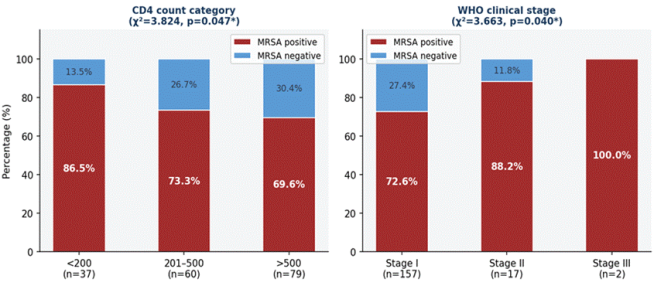
Methicillin-resistant Staphylococcus aureus (MRSA) poses a growing threat among people living with HIV/AIDS (PLWH) due to immunological vulnerability, frequent healthcare exposure, and compromised skin integrity. Despite a high HIV burden in Edo State, Nigeria, no data characterising MRSA colonisation in PLWH exist in the State. This study characterised MRSA colonisation among HIV/AIDS Clients of Irrua Specialist Teaching Hospital (ISTH). This is a cross-sectional hospital-based study, with 176 PLWH on ART for ≥6 months systematically enrolled. Three rayon swabs per participant were collected from the nasal vestibule, axillary fold, and groin. MRSA was confirmed by cefoxitin disc diffusion per Clinical Laboratory Standard Institute guidelines. Frequencies, proportions, chi-square, Fisher's exact test, and Kruskal-Wallis H were applied. Significance was set at p<0.05. Of 176 participants, 131 (74.43%) were MRSA-positive, yielding 230 isolates from 528 specimens (43.6% specimen-level positivity). Females predominates, constituted 75.0% (n=132) with overall mean age of 41.78±12.9 years. Majority were married (71.0%), had secondary education (51.1%), and were unskilled workers (65.3%). The groin yielded highest MRSA-positive swabs (94/176, 53.4%), followed by nasal (71/176, 40.3%) and axillary (65/176, 36.9%). MRSA carriage was significantly associated with age group (χ2=9.900, p=0.042), occupation (χ2=7.173, p=0.047), WHO clinical stage (χ2=3.663, p=0.040), and CD4 count category (χ2=3.824, p=0.047). The median CD4+ count was 425 cells/µL; participants with CD4 <200 had the highest MRSA positivity (86.5%). MRSA colonisation was high among PLWH at ISTH. The groin-predominant distribution challenges conventional nasal-centric screening paradigms. CD4-stratified MRSA rates and WHO stage associations indicate that immunosuppression contributes to MRSA carriage, supporting targeted screening of the most immunocompromised PLWH.
| Published in | International Journal of Microbiology and Biotechnology (Volume 11, Issue 3) |
| DOI | 10.11648/j.ijmb.20261103.14 |
| Page(s) | 123-133 |
| Creative Commons |
This is an Open Access article, distributed under the terms of the Creative Commons Attribution 4.0 International License (http://creativecommons.org/licenses/by/4.0/), which permits unrestricted use, distribution and reproduction in any medium or format, provided the original work is properly cited. |
| Copyright |
Copyright © The Author(s), 2026. Published by Science Publishing Group |
Methicillin-resistant Staphylococcus aureus, HIV/AIDS, PLWH, Colonisation Anatomical Site, Nigeria, Multi-site Carriage
Variable | Frequency (n) | Percentage (%) |
|---|---|---|
Age group (years) | ||
≤20 | 18 | 10.2 |
21-30 | 14 | 8.0 |
31-40 | 45 | 25.6 |
41-50 | 47 | 26.7 |
51-60 | 40 | 22.7 |
>60 | 12 | 6.8 |
Mean ± SD | 41.78 ± 12.9 years | |
Sex | ||
Female | 132 | 75.0 |
Male | 44 | 25.0 |
Religion | ||
Christianity | 158 | 89.8 |
Islam | 18 | 10.2 |
Marital status | ||
Married | 125 | 71.0 |
Single | 31 | 17.6 |
Widowed | 15 | 8.5 |
Divorced/Separated | 5 | 2.8 |
Level of education | ||
Secondary | 90 | 51.1 |
Primary | 45 | 25.6 |
Tertiary | 36 | 20.5 |
No formal education | 5 | 2.8 |
Occupation | ||
Unskilled | 115 | 65.3 |
Skilled | 31 | 17.6 |
Professional | 19 | 10.8 |
None/Not applicable | 11 | 6.3 |
Residential area | ||
Suburban | 93 | 52.8 |
Rural | 57 | 32.4 |
Urban | 26 | 14.8 |
N=176 participants. All percentages are participant-level. | ||
Variable | Frequency (n) | Percentage (%) |
|---|---|---|
Hospitalisation (last 12 months) | ||
Yes | 48 | 27.3 |
No | 128 | 72.7 |
Surgery (last 12 months) | ||
Yes | 7 | 4.0 |
No | 169 | 96.0 |
Nose picking | ||
Never | 33 | 18.8 |
Occasional | 94 | 53.4 |
Always | 49 | 27.8 |
Keeping of long nails | ||
Yes | 31 | 17.6 |
No | 145 | 82.4 |
Use of invasive device | ||
Yes | 65 | 36.9 |
No | 111 | 63.1 |
Underlying disease | ||
Yes | 49 | 27.8 |
No | 127 | 72.2 |
Hand covering while sneezing | ||
Yes | 127 | 71.0 |
No | 51 | 29.0 |
Previous use of antibiotics | ||
Yes | 54 | 30.7 |
No | 122 | 69.3 |
Skin infection at visit | ||
Yes | 26 | 14.8 |
No | 150 | 85.2 |
On any medication | ||
Yes | 51 | 29.0 |
No | 125 | 71.0 |
Current Cotrimoxazole use | ||
Yes | 149 | 84.7 |
No | 27 | 15.3 |
N=176 participants. All percentages are participant-level. | ||
Groin | Nasal | Axilla | |
|---|---|---|---|
Specimen-level positivity | |||
MRSA-positive specimens (n) | 94 | 71 | 65 |
% of 176 specimens per site | 53.4% | 40.3% | 36.9% |
Participant-level prevalence (N=176) | |||
Overall MRSA prevalence | 131/176 = 74.43% | ||
MRSA-negative participants | 45/176 = 25.57% | ||
Total specimen positivity | |||
Total MRSA-positive specimens | 230/528 = 43.6% | ||
Specimen-level rates calculated as n positive / 176 (specimens per site). Participant-level prevalence = proportion of 176 participants with ≥1 MRSA-positive swab. | |||
Variable | MRSA Positive n (%) | MRSA Negative n (%) | χ2 | p-value |
|---|---|---|---|---|
Age group (years) χ2=9.900, p=0.042* | ||||
≤20 | 10 (55.6) | 8 (44.4) | ||
21-30 | 12 (85.7) | 2 (14.3) | ||
31-40 | 36 (80.0) | 9 (20.0) | ||
41-50 | 38 (80.9) | 9 (19.1) | ||
51-60 | 29 (72.6) | 11 (27.5) | ||
>60 | 6 (50.0) | 6 (50.0) | ||
Sex χ2=0.249, p=0.618 (NS) | ||||
Male | 34 (77.3) | 10 (22.7) | 0.249 | 0.618 |
Female | 97 (73.5) | 35 (26.5) | ||
Marital status χ2=4.163, p=0.244 (NS) | ||||
Single | 20 (64.5) | 11 (35.5) | 4.163 | 0.244 |
Married | 96 (76.8) | 29 (23.2) | ||
Divorced/Separated | 5 (100.0) | 0 (0.0) | ||
Widowed | 10 (66.7) | 5 (33.3) | ||
Level of education χ2=2.072, p=0.558 (NS) | ||||
None | 4 (80.0) | 1 (20.0) | 2.072 | 0.558 |
Primary | 32 (71.1) | 13 (28.9) | ||
Secondary | 65 (72.2) | 25 (27.8) | ||
Tertiary | 30 (83.3) | 6 (16.7) | ||
Occupation χ2=7.173, p=0.047* | ||||
None/Not applicable | 7 (63.6) | 4 (36.4) | 7.173 | 0.047* |
Unskilled | 80 (69.6) | 35 (30.4) | ||
Skilled | 28 (90.3) | 3 (9.7) | ||
Professional | 16 (84.2) | 3 (15.8) | ||
Residential area χ2=1.126, p=0.570 (NS) | ||||
Rural | 40 (70.2) | 17 (29.8) | 1.126 | 0.570 |
Sub-urban | 70 (75.3) | 23 (24.7) | ||
Urban | 21 (80.8) | 5 (19.2) | ||
* p<0.05. NS=not significant. n=131 MRSA positive; n=45 MRSA negative. | ||||
Variable | MRSA Positive n (%) | MRSA Negative n (%) | χ2 | p-value |
|---|---|---|---|---|
Hospitalisation (Yes) | 35 (72.9) | 13 (27.1) | 0.080 | 0.778 |
Surgery (Yes) | 3 (42.9) | 4 (57.1) | 3.819 | 0.072 |
Nose picking: Never | 24 (72.7) | 9 (27.3) | 1.220 | 0.543 |
Nose picking: Occasional | 73 (77.7) | 21 (22.3) | ||
Nose picking: Always | 34 (69.4) | 15 (30.6) | ||
Long nails (Yes) | 23 (74.2) | 8 (25.8) | 0.001 | 0.973 |
Invasive device (Yes) | 47 (72.3) | 18 (27.7) | 0.244 | 0.621 |
Underlying disease (Yes) | 35 (71.4) | 14 (28.6) | 0.322 | 0.571 |
Hand covering (Yes) | 92 (73.6) | 33 (26.4) | 0.157 | 0.692 |
Prior antibiotics (Yes) | 40 (74.1) | 14 (25.9) | 0.005 | 0.942 |
Skin infection (Yes) | 19 (73.1) | 7 (26.9) | 0.029 | 0.864 |
On medication (Yes) | 34 (66.7) | 17 (33.3) | 2.275 | 0.131 |
Cotrimoxazole (Yes) | 113 (75.8) | 36 (24.2) | 1.010 | 0.315 |
None of the clinical variables reached significance at α=0.05. Hospitalization and surgery refer to the preceding 12 months. | ||||
Variable | MRSA Positive n (%) | MRSA Negative n (%) | χ2 | p-value |
|---|---|---|---|---|
WHO clinical stage χ2=3.663, p=0.040* | ||||
Stage I | 114 (72.6) | 43 (27.4) | 3.663 | 0.040* |
Stage II | 15 (88.2) | 2 (11.8) | ||
Stage III | 2 (100.0) | 0 (0.0) | ||
CD4+ count (cells/µL) χ2=3.824, p=0.047* | ||||
<200 | 32 (86.5) | 5 (13.5) | 3.824 | 0.047* |
201-500 | 44 (73.3) | 16 (26.7) | ||
>500 | 55 (69.6) | 24 (30.4) | ||
Viral load (copies/mL) χ2=0.827, p=0.661 (NS) | ||||
≤20 | 97 (75.2) | 32 (24.8) | 0.827 | 0.661 |
21-500 | 22 (68.8) | 10 (31.3) | ||
>500 | 12 (80.0) | 3 (20.0) | ||
* p<0.05. NS=not significant. WHO stage classification per WHO 2007 criteria. | ||||
AIDS | Acquired Immune Deficiency Syndrome |
ART | Antiretroviral Therapy |
CD | Cluster of Differentiation |
HIV | Human Immunodeficiency Virus |
ISTH | Irrua Specialist Teaching Hospital, Irrua |
MRSA | Methicillin-Resistant Staphylococcus aureus |
PLWH | People Living with HIV/AIDS |
| [1] | Bennett RW, Hait JM, Tallent SM. Staphylococcus aureus Infection. Guide to Foodborne Pathogens, Second Edition. 2025 Dec 1; 26-44. |
| [2] | Salam MA, Al-Amin MY, Salam MT, Pawar JS, Akhter N, Rabaan AA, et al. Antimicrobial Resistance: A Growing Serious Threat for Global Public Health. Healthcare. 2023 Jul 1; 11(13): 1946. |
| [3] | Thacharodi A, Hassan S, Ahmed T, Acharya G, Geli Blacknell NM, Singh P, et al. Methicillin-resistant Staphylococcus aureus is raising global concern as it overcomes immune challenges through various virulence mechanisms. iScience. 2025 Jan 16; 29(1): 114376. |
| [4] | Shoaib M, Aqib AI, Muzammil I, Majeed N, Bhutta ZA, Kulyar MF e. A, et al. MRSA compendium of epidemiology, transmission, pathophysiology, treatment, and prevention within one health framework. Front Microbiol. 2023 Jan 10; 13: 1067284. |
| [5] | Gajdács M. The continuing threat of methicillin-resistant Staphylococcus aureus. Antibiotics. 2019 Jun 1; 8(2). |
| [6] | Farley JE, Hayat MJ, Sacamano PL, Ross T, Carroll K. Prevalence and Risk Factors for MRSA in an HIV-positive Cohort. Am J Infect Control. 2015; 43(4): 329. |
| [7] | Igwe JC, Nkom PJ, Durowaiye MT, Obajuluwa AF, Parom SK. Methicillin Resistant Staphylococcus aureus Colonization among HIV Patients. SciMed J. 2023 Sep 1; 5(3): 107-17. |
| [8] | Muhammadul-Awwal Irodatullah Bisola, Gbolhan Olatunji, Emmanuel Kokori, Abdulhafeez Ayodele Mustapha, Godfred Yawson Scot, Ikponmwosa Jude Ogieuh, Nathaniel Abera Woldehana, Anthony Chidera Stanley, Oyakhire Aizenosa Olohita, Ayedun Samuel Abiola, David B. Olawade, Nicholas Aderinto. Emmerging Challenges in innate immunity: Staphylococcus aureus band healthcare-associated infection. Journal of Medicine, Surgery and Public Health; 2024(3): 100103. |
| [9] | Anshory M, Kalim H, Nouwen JL, Thio HB. HIV-Associated Dermatological Alterations: Barrier Dysfunction, Immune Impairment, and Microbiome Changes. International Journal of Molecular Sciences 2025, Vol 26,. 2025 Mar 30; 26(7). |
| [10] | Garg T, Sanke S. Inflammatory dermatoses in human immunodeficiency virus. Indian J Sex Transm Dis AIDS. 2017 Jul 1; 38(2): 113. |
| [11] | Boggio CMT, Veronese F, Armari M, Zavattaro E, Esposto E, Savoia P, et al. Skin microbiota in atopic dermatitis: victim or executioner? Clin Microbiol Rev. 2025 Sep 1; 38(3). |
| [12] | Abdullahi IN, Issaoui R, Usman Y. Prevalence and genetic lineages of Staphylococcus aureus nasal colonization and urinary tract infection among people living with HIV/AIDS in Nigeria: A systematic review. IJID Regions. 2022 Sep 1; 4: 17. |
| [13] | Muluneh Assefa and Getu Girmay. Prevalence of Co-trimoxazole resistance among HIV-infected individuals in Ethopia: a systematic review and meta-analysis. Front. Med., 2024(11). |
| [14] | Sabbagh P, Riahi SM, Gamble HR, Rostami A. The global and regional prevalence, burden, and risk factors for methicillin-resistant Staphylococcus aureus colonization in HIV-infected people: A systematic review and meta-analysis. Am J Infect Control. 2019 Mar 1; 47(3): 323-33. |
| [15] | Neupane K, Rayamajhee B, Acharya J, Rijal N, Shrestha D, G C B, et al. Comparison of Nasal Colonization of Methicillin-Resistant Staphylococcus aureus in HIV-Infected and Non-HIV Patients Attending the National Public Health Laboratory of Central Nepal. Canadian Journal of Infectious Diseases and Medical Microbiology. 2018 Jan 1; 2018(1): 4508757. |
| [16] | Federal Ministry of Health (FMOH), National Agency for the Control of AIDS (NACA), University of Maryland (UMB). Nigeria HIV-AIDS Indicator and Impact Survey (NAIIS) 2018. Abuja, Nigeria; 2021. |
| [17] | Onovo AA, Adeyemi A, Onime D, Kalnoky M, Kagniniwa B, Dessie M, et al. Estimation of HIV prevalence and burden in Nigeria: a Bayesian predictive modelling study. EClinicalMedicine. 2023 Aug 1; 62. |
| [18] | UNAIDS, Federal Ministry of Health (FMOH), National Agency for the Control of AIDS (NACA). New survey results indicate that Nigeria has an HIV prevalence of 1.4%. Abuja, Nigeria / Geneva, Switzerland; 2019. |
| [19] | Job, Patience Abiye; Alo, Moses; Nwokah Easter Gospel and Aaron Umasoye. Nasal Carriage Prevalence of MRSA in People Living with HIV/AIDS Undertaking Antiretroviral Therapy in a Tertiary Hospital in Port Harcourt. International Journal of Inniviative Healthcare Research 2018; 6(1): 12-33. |
| [20] | Egyir, B., Oteng, A. A., Owusu, E., Newman, M. J., Addo, K. K., & Larsen, A. R. Characterisation of Staphyloccus aureus from human immunodeficiency virus (HIV) patients in Accra, Ghana. Journal of Infection in Developing Countries, 2016; 10(5): 453-456. |
| [21] | Weldegebreal F, Urgesa K, Ayele F, Bogale K, Shume T, Ahmed M, et al. Nasal carriage rate, associated factors, and antimicrobial susceptibility patterns of methicillin resistance Staphylococcus aureus among pre-clinical undergraduate students at the College of Health and Medical Sciences, Haramaya University, Ethiopia. Front Public Health. 2024 May 23; 12: 1354461. |
| [22] | Abimana JB, Kato CD, Bazira J. Methicillin-Resistant Staphylococcus aureus Nasal Colonization among Healthcare Workers at Kampala International University Teaching Hospital, Southwestern Uganda. Canadian Journal of Infectious Diseases and Medical Microbiology. 2019 Jan 1; 2019(1): 4157869. |
| [23] | Chimbetete T, Buck C, Choshi P, Selim R, Pedretti S, Divito SJ, et al. HIV-Associated Immune Dysregulation in the Skin: A Crucible for Exaggerated Inflammation and Hypersensitivity. J Invest Dermatol. 2022 Mar 1; 143(3): 362. |
| [24] | Aiken AM, Mutuku IM, Sabat AJ, Akkerboom V, Mwangi J, Scott JAG, et al. Carriage of Staphylococcus aureus in Thika Level 5 Hospital, Kenya: a cross-sectional study. Antimicrob Resist Infect Control. 2014 Jul 15; 3(1): 22. |
| [25] | Kateete DP, Bwanga F, Seni J, Mayanja R, Kigozi E, Mujuni B, et al. CA-MRSA and HA-MRSA coexist in community and hospital settings in Uganda. Antimicrob Resist Infect Control. 2019 Dec 3; 8(1): 94. |
APA Style
Joan, O. I., Morufu, A. G., Sunday, S. O., Egbedion, U. A., Obulimi, O. T. (2026). Sociodemographic Characteristics of Methicillin-Resistant Staphylococcus aureus Colonisation Among HIV/AIDS Clients of a Public Hospital in South-South Nigeria. International Journal of Microbiology and Biotechnology, 11(3), 123-133. https://doi.org/10.11648/j.ijmb.20261103.14
ACS Style
Joan, O. I.; Morufu, A. G.; Sunday, S. O.; Egbedion, U. A.; Obulimi, O. T. Sociodemographic Characteristics of Methicillin-Resistant Staphylococcus aureus Colonisation Among HIV/AIDS Clients of a Public Hospital in South-South Nigeria. Int. J. Microbiol. Biotechnol. 2026, 11(3), 123-133. doi: 10.11648/j.ijmb.20261103.14
AMA Style
Joan OI, Morufu AG, Sunday SO, Egbedion UA, Obulimi OT. Sociodemographic Characteristics of Methicillin-Resistant Staphylococcus aureus Colonisation Among HIV/AIDS Clients of a Public Hospital in South-South Nigeria. Int J Microbiol Biotechnol. 2026;11(3):123-133. doi: 10.11648/j.ijmb.20261103.14
@article{10.11648/j.ijmb.20261103.14,
  author = {Ogbue Itohan Joan and Adewuyi Gbolagade Morufu and Samuel Olowo Sunday and Unuane Amos Egbedion and Otumu Tabitha Obulimi},
  title = {Sociodemographic Characteristics of Methicillin-Resistant Staphylococcus aureus Colonisation Among HIV/AIDS Clients of a Public Hospital in South-South Nigeria},
  journal = {International Journal of Microbiology and Biotechnology},
  volume = {11},
  number = {3},
  pages = {123-133},
  doi = {10.11648/j.ijmb.20261103.14},
  url = {https://doi.org/10.11648/j.ijmb.20261103.14},
  eprint = {https://article.sciencepublishinggroup.com/pdf/10.11648.j.ijmb.20261103.14},
  abstract = {Methicillin-resistant Staphylococcus aureus (MRSA) poses a growing threat among people living with HIV/AIDS (PLWH) due to immunological vulnerability, frequent healthcare exposure, and compromised skin integrity. Despite a high HIV burden in Edo State, Nigeria, no data characterising MRSA colonisation in PLWH exist in the State. This study characterised MRSA colonisation among HIV/AIDS Clients of Irrua Specialist Teaching Hospital (ISTH). This is a cross-sectional hospital-based study, with 176 PLWH on ART for ≥6 months systematically enrolled. Three rayon swabs per participant were collected from the nasal vestibule, axillary fold, and groin. MRSA was confirmed by cefoxitin disc diffusion per Clinical Laboratory Standard Institute guidelines. Frequencies, proportions, chi-square, Fisher's exact test, and Kruskal-Wallis H were applied. Significance was set at p2=9.900, p=0.042), occupation (χ2=7.173, p=0.047), WHO clinical stage (χ2=3.663, p=0.040), and CD4 count category (χ2=3.824, p=0.047). The median CD4+ count was 425 cells/µL; participants with CD4 <200 had the highest MRSA positivity (86.5%). MRSA colonisation was high among PLWH at ISTH. The groin-predominant distribution challenges conventional nasal-centric screening paradigms. CD4-stratified MRSA rates and WHO stage associations indicate that immunosuppression contributes to MRSA carriage, supporting targeted screening of the most immunocompromised PLWH.},
 year = {2026}
}
TY  - JOUR
T1  - Sociodemographic Characteristics of Methicillin-Resistant Staphylococcus aureus Colonisation Among HIV/AIDS Clients of a Public Hospital in South-South Nigeria
AU  - Ogbue Itohan Joan
AU  - Adewuyi Gbolagade Morufu
AU  - Samuel Olowo Sunday
AU  - Unuane Amos Egbedion
AU  - Otumu Tabitha Obulimi
Y1  - 2026/09/08
PY  - 2026
N1  - https://doi.org/10.11648/j.ijmb.20261103.14
DO  - 10.11648/j.ijmb.20261103.14
T2  - International Journal of Microbiology and Biotechnology
JF  - International Journal of Microbiology and Biotechnology
JO  - International Journal of Microbiology and Biotechnology
SP  - 123
EP  - 133
PB  - Science Publishing Group
SN  - 2578-9686
UR  - https://doi.org/10.11648/j.ijmb.20261103.14
AB  - Methicillin-resistant Staphylococcus aureus (MRSA) poses a growing threat among people living with HIV/AIDS (PLWH) due to immunological vulnerability, frequent healthcare exposure, and compromised skin integrity. Despite a high HIV burden in Edo State, Nigeria, no data characterising MRSA colonisation in PLWH exist in the State. This study characterised MRSA colonisation among HIV/AIDS Clients of Irrua Specialist Teaching Hospital (ISTH). This is a cross-sectional hospital-based study, with 176 PLWH on ART for ≥6 months systematically enrolled. Three rayon swabs per participant were collected from the nasal vestibule, axillary fold, and groin. MRSA was confirmed by cefoxitin disc diffusion per Clinical Laboratory Standard Institute guidelines. Frequencies, proportions, chi-square, Fisher's exact test, and Kruskal-Wallis H were applied. Significance was set at p2=9.900, p=0.042), occupation (χ2=7.173, p=0.047), WHO clinical stage (χ2=3.663, p=0.040), and CD4 count category (χ2=3.824, p=0.047). The median CD4+ count was 425 cells/µL; participants with CD4 <200 had the highest MRSA positivity (86.5%). MRSA colonisation was high among PLWH at ISTH. The groin-predominant distribution challenges conventional nasal-centric screening paradigms. CD4-stratified MRSA rates and WHO stage associations indicate that immunosuppression contributes to MRSA carriage, supporting targeted screening of the most immunocompromised PLWH.
VL  - 11
IS  - 3
ER  -
Department of Medical Microbiology and Parasitology, Irrua Specialist Teaching Hospital, Irrua, Nigeria;Department of Medical Microbiology and Parasitology, Ambrose Alli University, Ekpoma, Nigeria
Department of Medical Microbiology and Parasitology, Irrua Specialist Teaching Hospital, Irrua, Nigeria;Department of Medical Microbiology and Parasitology, Ambrose Alli University, Ekpoma, Nigeria
Department of Medical Microbiology and Parasitology, Irrua Specialist Teaching Hospital, Irrua, Nigeria;Department of Medical Microbiology and Parasitology, Ambrose Alli University, Ekpoma, Nigeria
Department of Medical Microbiology and Parasitology, Irrua Specialist Teaching Hospital, Irrua, Nigeria;Department of Medical Microbiology and Parasitology, Ambrose Alli University, Ekpoma, Nigeria
Department of Medical Microbiology and Parasitology, Irrua Specialist Teaching Hospital, Irrua, Nigeria;Department of Medical Microbiology and Parasitology, Ambrose Alli University, Ekpoma, Nigeria

Information


 Share This Article
 Twitter
 Linked In
 Facebook
 Copy
Copy Download